
In a perfect world, architectural drawings meet physical reality without a single variance. Structural walls would sit at a perfect 90-degree angle, and subfloors would be absolutely level. However, seasoned general contractors and custom millwork designers in Ontario know that a perfectly square room is a myth. Whether dealing with a century-old home in the Greater Toronto Area (GTA) or a brand-new residential development in London, walls bow, floors sag, and corners lean out of plumb.
When installing modern, rigid cabinet carcasses, especially European modular systems like IKEA SEKTION, installers cannot simply slam boxes against wavy drywall. Doing so creates a twisted, unlevel base that ruins countertop installations and misaligns drawer faces.
To achieve millimeter-precision, professional installers rely on two core mechanical techniques: Shimming and Scribing. Understanding how and when to deploy these methods is what separates an amateur DIY job from a master-tier cabinetry execution.
1. Cabinet Shimming: Building a Level Foundation
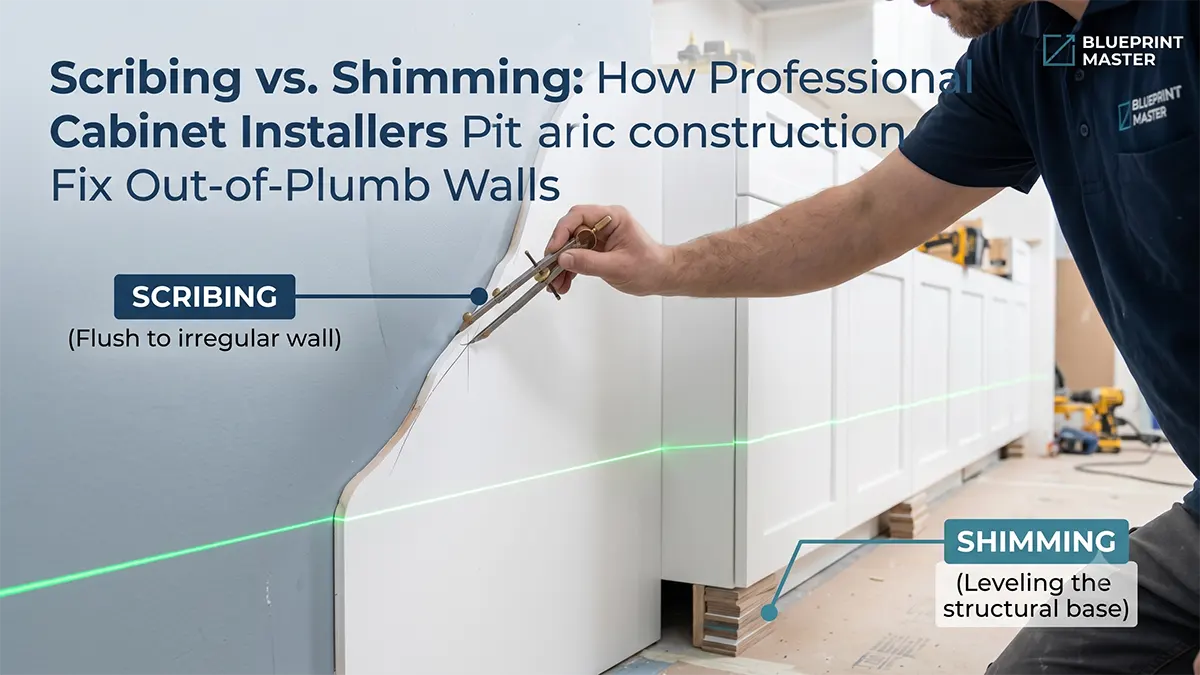
Shimming is the process of inserting thin, tapered wedges of wood, composite, or plastic behind or beneath a cabinet frame to lift, lower, or push it into a perfectly level plane.
The Role of the Shim in Structural Anchoring
Because base cabinets must establish a perfectly flat, monolithic surface for heavy stone countertops, they must be aligned using a high-precision crosshair laser level. If the floor drops by 4mm across a short span, the installer inserts load-bearing shims under the cabinet base or legs until the frame perfectly intersects the laser line.
Key Rules for Professional Shimming:
-
Load-Bearing Security: Shims must be placed directly beneath the load-bearing vertical gables of the cabinet carcass, not just under the flimsy bottom panels.
-
No Drywall Crushing: When backing a suspension rail, shims must fill the void completely between the steel rail and the studs. Tightening a structural screw without a shim into a bowed wall will warp the rail and twist the cabinet out of square.
2. Cabinet Scribing: The Art of Seamless Wall Intersections
While shimming moves the cabinet boxes into a square and level position, it inevitably leaves uneven gaps between the straight cabinet sides and the wavy, out-of-plumb structural walls. This is where scribing comes into play.
Scribing is the highly technical carpentry practice of transferring the exact custom, wavy profile of an irregular wall onto a straight piece of finished lumber, molding, or filler panel, and then cutting it to fit flush with zero gaps.
The Scribing Workflow:
-
The Grid Lock: The cabinet box is shimmed and locked into its permanent, level position, leaving a variable gap against the leaning wall.
-
Drawing the Wave: The installer uses a specialized carpentry compass or scriber. One point tracks along the irregular drywall surface, while the pencil lead mimics that exact wave onto the finished filler strip.
-
The Micro-Cut: The installer uses a jigsaw or a hand plane with a fine-tooth blade, back-cutting at a slight angle so the front finished edge tightly hugs the drywall.
The result is an architectural illusion: the cabinet looks as if it has been carved directly into the wall structure, with completely closed seams that require zero messy caulking.
3. Why Proper Wall Compensation Minimizes Cumulative Error
Cabinetry installation is an exercise in managing cumulative tolerances. If an installer ignores a minor 1.5mm wall bow on the first upper cabinet box, that error will tilt the second box. By the time the installer reaches the end of a 15-foot run, the final cabinet will be twisted out of alignment by over 10mm.
What Happens If Walls Are Not Professionally Compensated?
-
Countertop Stress Fractures: Quartz, granite, and marble fabricators require base cabinets to be level within +/- 1.5mm across the entire run. If the shimming is uneven, the stone slab will span across a hollow void. Over time, the weight of appliances or everyday kitchen use will cause the stone to crack along its weakest points.
-
Binding Hardware and Drawer Failures: High-end soft-close drawer slides and dynamic Blum hinges require a perfectly square box to function. If a cabinet is forced to conform to a twisted wall without shims, the frame will warp. This friction causes drawers to scrape, bind, or drift open on their own.
The Blueprint Master Precision Guarantee
At Blueprint Master, we treat wall irregularities as a standard part of our engineering blueprint. Our mobile crews map out your environment using commercial-grade self-leveling laser networks before a single anchor is mounted. By combining heavy-duty, load-bearing shimming with meticulous hand-scribed filler panels, we ensure that your finished cabinetry lines sit perfectly square, plumb, and flush.
Whether you are an independent showroom managing custom displays or a builder coordinating residential rollouts in Southwestern Ontario, contract an installation team that understands structural geometry. Submit your blueprint packages to our estimating desk today to secure an itemized fixed-price quote.